Look a little closer
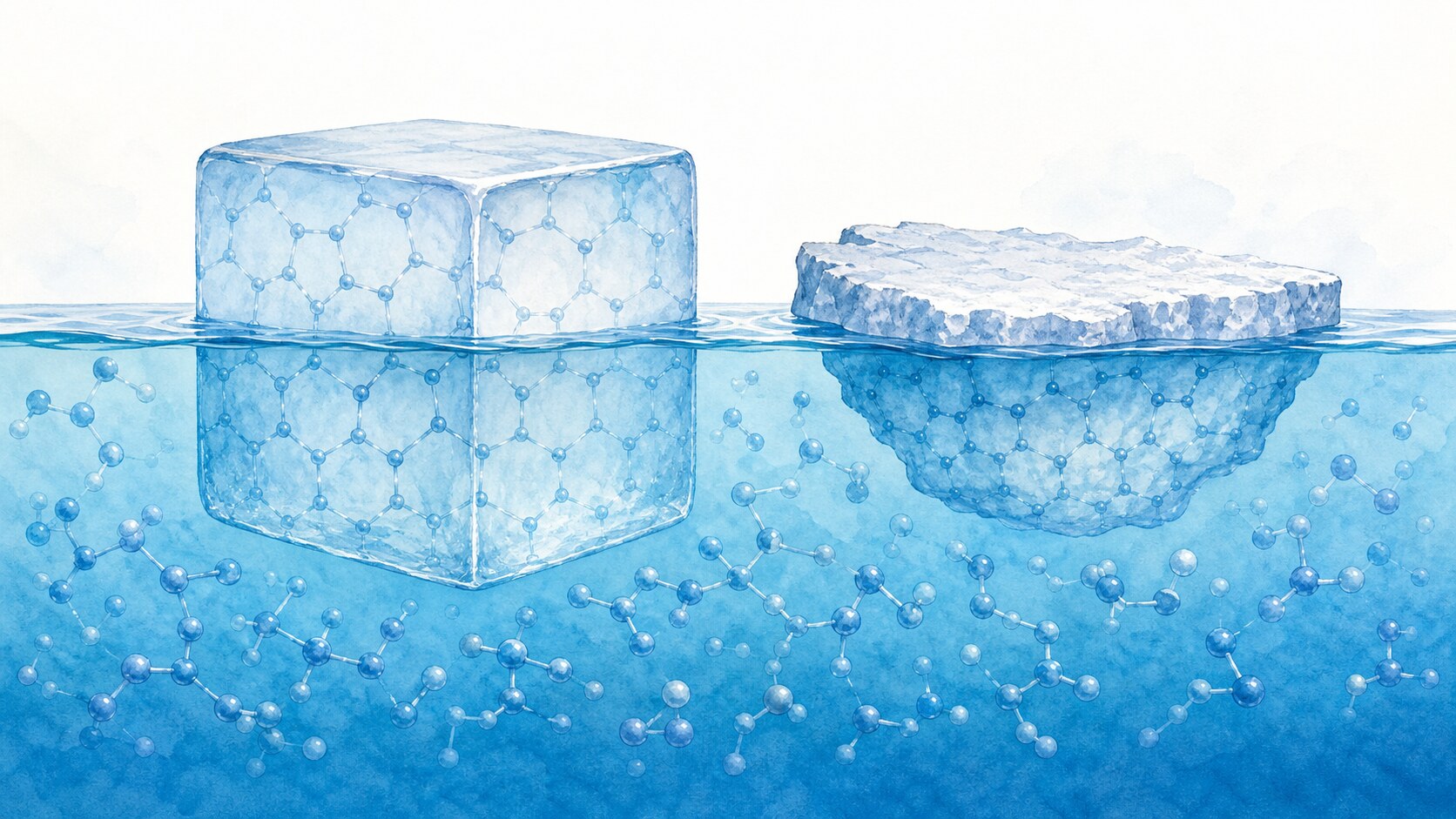
Ice floats because a given volume of ordinary ice has less mass than the same volume of liquid water. That ratio of mass to volume is density. When an ice cube is placed in water, it sinks only until it has displaced a weight of water equal to its own weight. Because the ice is less dense, that balance is reached before the whole cube goes below the surface.
The difference begins with the shape of a water molecule and the way neighbouring molecules attract one another. Each molecule has one oxygen atom and two hydrogen atoms, and water molecules can form attractions called hydrogen bonds. In liquid water, those bonds continually break and reform, allowing the molecules to move around and pack comparatively close together.
As water freezes, molecular motion slows and hydrogen bonds organize the molecules into a regular crystal lattice. The common form of ice at everyday pressure has an open hexagonal arrangement with more empty space than liquid water. The same number of molecules therefore occupies a larger volume. Water expands by about 9 percent on freezing, while the density falls by roughly the same proportion.
That is why an ice cube does not sit entirely above the water. Ordinary ice has about 90 percent of liquid water’s density, so only around one-tenth of a floating cube or iceberg rises above fresh water. The exact fraction can shift because natural ice may contain trapped air or impurities, and seawater is denser than fresh water because it contains dissolved salts.
Liquid water also behaves unusually before it freezes. It reaches its greatest density near 4 degrees Celsius rather than at the freezing point. In a cooling freshwater lake, water near 4 degrees tends to sink while colder, slightly less-dense water remains above it. The surface layer can then reach the freezing point and turn to floating ice first.
A surface ice layer also slows heat transfer between the water below and the cold air above. This does not guarantee that a lake can never freeze deeply, but it delays whole-lake freezing and often leaves liquid habitat beneath the ice. The same molecular geometry that makes an ice cube bob in a drink therefore helps shape the winter structure of lakes.
The rule has boundaries. Salinity changes both water density and freezing temperature, and unusual materials can reverse the familiar result: ice made from heavy water is denser than ordinary water and can sink in it. The useful general statement is not that every kind of frozen water always floats, but that ordinary ice floats because its open crystal structure makes it less dense than the liquid around it.
EDITORIAL RESPONSIBILITY
FactosBrain Editorial Desk
The FactosBrain Editorial Desk researched and reviewed this article under our editorial policy. We assess error reports under our corrections policy.